Yarddy guide
Yard Sale, Garage Sale, Moving Sale, and Estate Sale: What Is the Difference?
The labels overlap, but they communicate useful expectations about scope, timing, inventory, and why the sale is happening.

Yard sale and garage sale
A yard sale and a garage sale usually describe the same general kind of owner-run local event: a household offers a mixed group of used items for a limited time. The name often reflects where the tables are set up rather than a meaningful legal distinction. Expect household goods, clothing, toys, tools, books, and small furniture, with inventory varying widely.
Sellers should choose the familiar term used in their area and describe the actual inventory instead of relying on the label alone. Buyers should use photos and categories to decide whether the sale matches their interests.
Moving sale
A moving sale signals a deadline and often a wider range of practical household items. Larger furniture, appliances, storage equipment, and décor may be more common because the seller is reducing what must be transported. Prices may become more flexible near the move date, but buyers should not assume every item is negotiable.
The listing should explain pickup deadlines for large items and whether a buyer must bring tools or loading help.
Estate sale
An estate sale generally involves a larger portion of a household's contents and may be organized by a family, representative, or professional company. Inventory can include furniture, collections, kitchenware, tools, clothing, art, and ordinary household items accumulated over many years. Some estate sales use numbered entry, controlled occupancy, fixed discount schedules, or specific payment rules.
The term should be used accurately and respectfully. A large garage sale is not automatically an estate sale. Sellers should state whether the event is professionally managed and explain entry or pickup procedures that differ from a typical yard sale.
Multi-family, block, and community sales
A multi-family sale combines items from several households at one location. A block or neighborhood sale involves multiple nearby addresses during a shared window. These events can offer greater variety, but buyers may need more time for parking and walking between participants.
Listings should explain whether there is one checkout area, several participating homes, a central map, or different hours for different locations.
Single-item listing and free item
A single-item listing is not a scheduled sale event. It represents one available item and should emphasize condition, price, dimensions or model information, and pickup or meeting expectations. A free item should be marked “Free” rather than given a zero-dollar price that looks accidental.
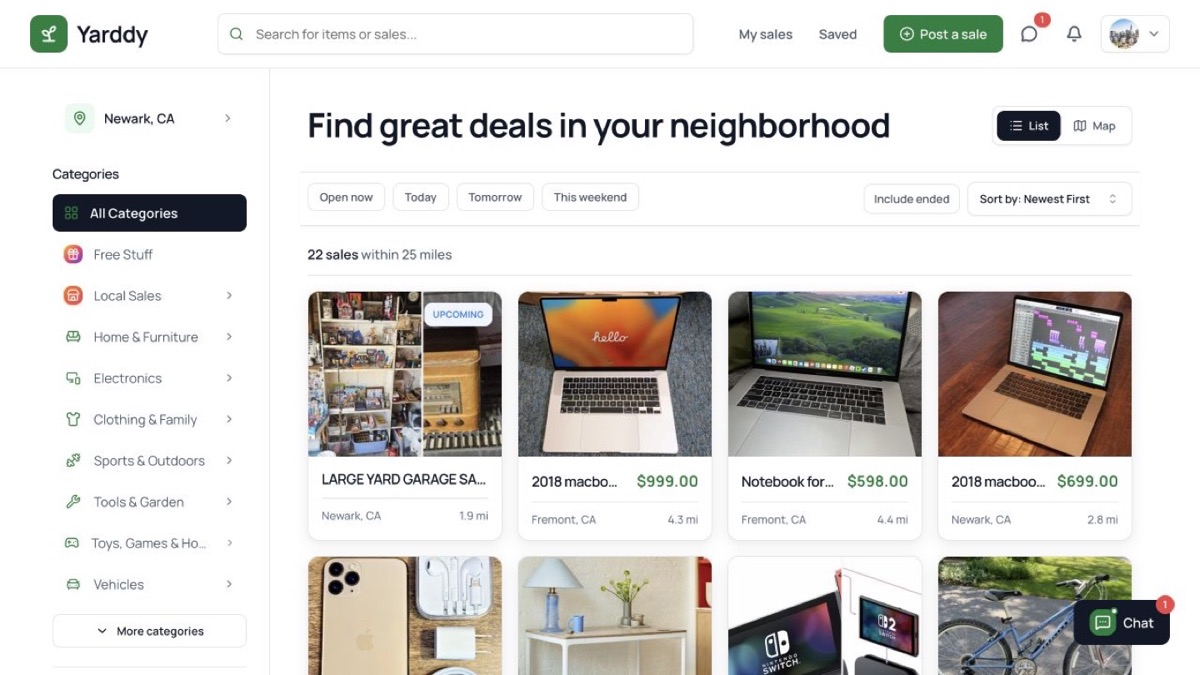
Yarddy keeps these items connected to local sale discovery while treating local sales as the primary experience. Accurate labeling helps buyers interpret availability and helps sellers receive the right questions.
Practical example
Choosing Local Sale instead of Item
A family must clear furniture, kitchenware, clothing, and tools before moving. Because buyers will visit during a defined weekend window and browse many items, the seller chooses Moving Sale rather than creating one oversized Item listing.
Result: The listing type sets the right expectation: a scheduled multi-item sale tied to a household move.
Quick-reference table
| What you have | Use | Why |
|---|---|---|
| One specific product | Item | Price and condition drive the decision |
| Many household goods at set hours | Yard or Garage Sale | Timing and variety matter |
| Household clearance before relocation | Moving Sale | The deadline explains inventory and pickup |
Practical checklist
- Choose the label that accurately reflects the scope of the sale.
- Describe the inventory instead of relying on the sale type alone.
- Explain special entry, discount, parking, or pickup procedures.
- Use a single-item listing when there is no scheduled sale event.
- Mark free items clearly as Free.
Frequently asked questions
Is a garage sale different from a yard sale?
The terms often describe the same household-sale format. The more important differences are inventory, schedule, scale, and whether the sale is tied to a move or estate.
Should a single item be posted as a Local Sale?
No. Use an Item listing for one product and a Local Sale for a scheduled yard, garage, moving, estate, craft, or similar multi-item sale.
Compare Local Sale types nearby
Browse active yard, garage, moving, and estate sales with clear schedules.